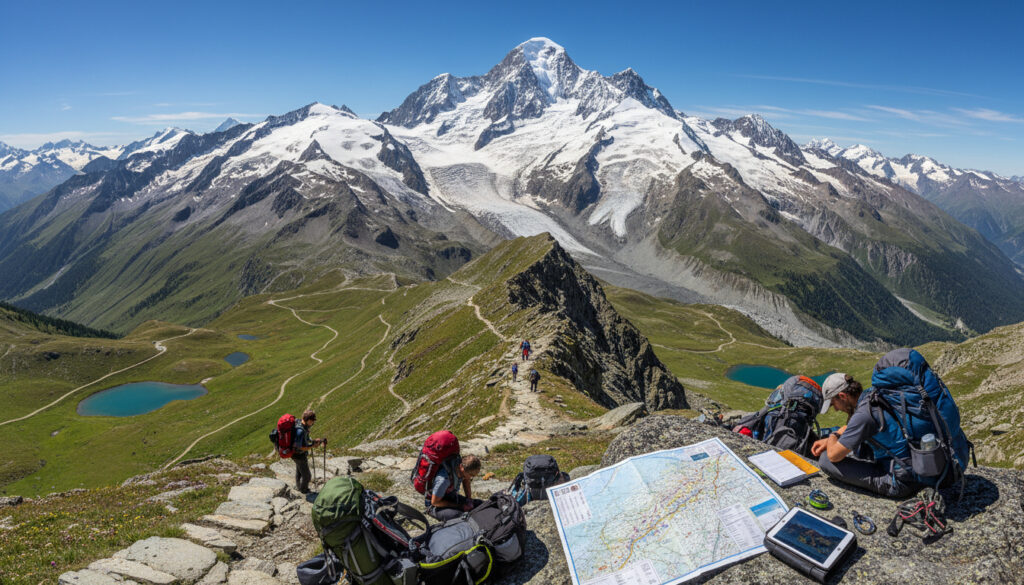
Tour du Mont Blanc – 2025 Itinerary Booking and Difficulty Guide
The Tour du Mont Blanc stands among Europe’s most iconic long-distance trails, tracing a 170-kilometer circuit around Western Europe’s highest peak. This hut-to-hut trek traverses three countries—France, Italy, and Switzerland—delivering approximately 10,000 meters of total elevation gain and loss across alpine meadows, glacial valleys, and high mountain passes.
Unlike wilderness expeditions requiring tents and cooking gear, the TMB offers a unique logistical framework. A network of over 160 mountain refuges and chamois huts provides shelter and meals, allowing hikers to traverse the massif with daypacks rather than heavy loads. The complete circuit typically demands 7 to 11 days depending on pacing and variant choices.
The trail has experienced surging popularity since 2020, with booking calendars filling months in advance. Success requires understanding the route’s physical demands, seasonal weather patterns, and the critical reservation systems governing accommodation along the circuit.
What is the Tour du Mont Blanc?
The classic TMB forms a continuous loop traditionally starting and ending in Les Houches or Chamonix in the French Alps. The route traces the perimeter of the Mont Blanc massif, crossing seven major valleys and utilizing high mountain passes that have served as trade routes for centuries. Interactive mapping tools confirm the standard distance at roughly 170 kilometers, though GPS measurements vary slightly depending on exact routing and side trips.
Key insights for 2025 hikers:
- Post-pandemic popularity has compressed booking windows to 6-12 months for high season
- Counterclockwise navigation attracts approximately 90% of trekkers
- Via ferrata variants exist for those seeking technical additions to standard hiking
- Wild camping faces strict restrictions in specific valleys, particularly near ladder sections
- The route overlaps with the GR5 long-distance trail on its southern French sections
- Microspikes remain essential safety equipment even during summer months
- Sustainable tourism practices increasingly govern refuge operations and trail usage
| Fact | Details |
|---|---|
| Total Length | 170 km continuous loop |
| Cumulative Ascent | ~10,000 m (equal descent) |
| Highest Point | Col de la Seigne (~2,516 m) |
| Standard Stages | 11 segments |
| Refuge Network | 160+ huts and campsites |
| Daily Distance | 10-20 km per stage |
| Daily Elevation | 800-1,500 m gain typical |
| Required Permits | None (park fees may apply) |
How Difficult is the Tour du Mont Blanc?
Physical and Technical Demands
Trail difficulty ratings categorize the TMB as high due to consecutive long days, steep mountain passes, and significant elevation changes. Daily segments range between 10 and 20 kilometers with vertical gains of 800 to 1,500 meters. Terrain varies from smooth alpine trails to rocky scree fields and sections requiring fixed ladders or cables, though bypass routes exist for most technical segments.
Weather exposure compounds the physical challenge. Trekkers face rapid atmospheric changes including afternoon thunderstorms, dense fog, and temperature drops at elevation. The combination of fatigue and variable conditions demands constant awareness and conservative decision-making.
Attempting the TMB without prior multi-day hiking experience significantly increases injury risk. The consecutive nature of the trek—typically 7 to 11 days without rest—requires established endurance baselines and familiarity with personal gear under load.
Essential Training Protocols
Preparation should commence three to six months before departure. Specialist guides recommend training focused on hill repeats, weighted backpack hikes carrying 8-12 kilograms, and consecutive days covering 20+ kilometers with significant elevation gain. Cardiovascular endurance alone proves insufficient; leg strength and joint stability under descending load determine success on steep downhill sections.
Best Time to Hike and Essential Planning
Seasonal Considerations and Weather Patterns
Alpine weather patterns dictate a narrow operational window. The prime season runs July through September when high passes remain snow-free and refuges operate at full capacity. Crowds peak between mid-July and mid-August, creating logistical challenges for spontaneous itinerary changes. Shoulder months of June and October offer solitude but present elevated risks of early or late-season snow that may render high passes treacherous without microspikes.
Daily weather variability remains constant throughout summer. Morning clarity often yields to afternoon thunderstorms above treeline. Hikers must monitor professional forecasting applications and possess the judgment to descend rapidly when electrical activity approaches.
Hut Booking Requirements
The TMB reservation system operates on a first-come, first-served basis with extraordinary lead times. High mountain refuges release booking calendars in the autumn preceding the summer season. For July and August departures, securing beds requires action between September and December of the prior year. DIY booking offers flexibility but demands time-intensive coordination across multiple telephone and email systems.
Refuge cancellations occasionally appear 30-60 days before arrival dates as trekkers finalize plans. Monitoring booking platforms during this final window sometimes yields options for those unable to secure reservations during the primary autumn booking period.
Budget and Cost Breakdown
Standard budgeting ranges €50-100 per person daily, covering half-board refuge accommodation (€60-90 nightly), meals, and trail snacks. A complete 10-day circuit typically costs €700-1,500 excluding international travel. Additional expenses include luggage transfer services (€10-20 daily), which transport bags between villages while hikers carry daypacks. Guided options streamline logistics but increase costs significantly. Wild camping—where permitted—reduces expenses but requires specific permits in certain valleys.
For comprehensive 2025-specific booking timelines and cost projections, consult the Tour du Mont Blanc 2025 Itinerary and Booking Guide.
Tour du Mont Blanc Itinerary and Map
Directional Options: Counterclockwise vs Clockwise
Directional choice fundamentally alters the trekking experience. The counterclockwise route, starting in Les Houches and following the traditional navigation favored by 90% of hikers, presents gentler initial terrain and gradual acclimatization. This orientation facilitates social interaction and established trail community rhythms.
Clockwise travel, typically commencing from Champex-Lac in Switzerland or utilizing the Brévent gondola to access the trail, offers markedly reduced crowds and enhanced solitude. However, this direction confronts trekkers immediately with challenging terrain, including the technical rocky descent into Trient that demands careful foot placement and slower progress than the counterclockwise equivalent.
Clockwise navigation provides unique valley perspectives invisible to counterclockwise trekkers, particularly approaching the Mont Blanc massif from the west. The diminished traffic allows for more spontaneous itinerary adjustments, though hikers must accept tougher initial elevation profiles.
Stage Variations and Route Flexibility
The traditional 11-stage itinerary represents merely one configuration among many. Modern trek planners enable custom routing incorporating public transit shortcuts, village hotel stays, and luggage transfer services that eliminate the need to carry full packs. Compression options allow completion of the western half (Chamonix to Courmayeur) in five days, while the “TMB Anytime” approach utilizes valley floors and bus connections to create modular itineraries.
Navigation resources have evolved substantially. Digital platforms now provide GPX tracks, elevation profiles, and real-time refuge availability checking. Hiker-generated content supplements official cartography with recent condition reports critical for assessing snow levels or trail obstructions.
Download offline navigation capabilities before departure. Cellular coverage remains intermittent along high passes and in deep valleys. Physical IGN France topographic maps serve as critical backup when digital devices fail.
For detailed stage-by-stage breakdowns including elevation charts and refuge contact information, reference the Tour du Mont Blanc 11-Day Itinerary and Prep Guide.
Critical Planning Timeline
- 12 months prior: Commence physical conditioning base and research preferred routing options
- 9 months prior: Book international travel and secure first/last night accommodation in Chamonix valley
- 6 months prior: Reserve refuge beds for July and August departures; finalize gear acquisition
- 3 months prior: Purchase comprehensive travel insurance including helicopter evacuation and acquire satellite communication devices
- 1 month prior: Download offline maps, check equipment functionality, and verify emergency contact protocols
- 2 weeks prior: Monitor extended weather forecasts and confirm microspike packing decisions based on snow reports
Established Facts and Persistent Uncertainties
Confirmed Parameters
- Fixed 170-kilometer distance with documented elevation profiles
- July-September operational season for high passes
- Standardized hut pricing structures (€60-90 half-board)
- Official counterclockwise routing as default
- Specific ladder and cable sections with mapped bypass variants
Variable Elements
- Year-to-year glacier melt impacts on specific trail segments
- Precise daily weather patterns and thunderstorm timing
- Real-time crowd density during peak weeks in August
- Future regulatory changes regarding wild camping permits
- Exact snowpack persistence at Col de la Seigne and Grand Col Ferret
Historical Context and Trail Significance
The Tour du Mont Blanc emerged from mountaineering circles in the 1950s, evolving from expedition-style circuits requiring extensive self-sufficiency to the supported hut-to-hut system operating today. The route now accommodates approximately 30,000 trekkers annually, representing a unique tri-national cooperation between France, Italy, and Switzerland regarding trail maintenance, refuge operations, and environmental protection protocols.
Comparisons frequently drawn to the GR20 in Corsica highlight the TMB’s superior infrastructure and accessibility, though both treks demand comparable fitness levels. The TMB’s circumnavigation of Western Europe’s highest summit—4,808 meters—provides a geological education spanning granite formations, glacial moraines, and alpine pastures now facing pressure from climate change and increased foot traffic.
Authority Perspectives and Safety Considerations
The combination of long days, steep passes, and exposure to sudden weather changes requires fit hikers with prior multi-day experience. Attempting to shortcut physical preparation invites injury in technical sections.
— Alpine Safety Analysis
Hut booking prior to summer requires 6-12 months advance planning. The DIY approach offers maximum flexibility but demands significant administrative effort coordinating across multiple countries and booking systems.
— Trekking Logistics Review
Is the Tour du Mont Blanc the Right Trek for You?
The TMB suits experienced hikers seeking hut-to-hut comfort within dramatic alpine terrain, provided they possess the endurance for consecutive demanding days and the organizational discipline to secure reservations months in advance. The route rewards thorough preparation with varied cultural experiences across three nations and some of Europe’s most spectacular mountain vistas. For those ready to commit to the training and planning requirements, the circuit delivers a definitive long-distance trekking experience. Begin planning your specific itinerary using the Tour du Mont Blanc 2025 Itinerary and Booking Guide.
Frequently Asked Questions
Can complete beginners hike the Tour du Mont Blanc?
The TMB is generally unsuitable for beginners despite its hut infrastructure. The consecutive days of 1,000+ meter elevation gains and exposure to alpine weather require established hiking endurance and experience managing gear and nutrition over multi-day periods.
What happens if I miss a hut reservation or arrive late?
Refuges operate strict cancellation policies. Late arrivals risk forfeiting beds and payment. Contingency planning should include alternative valley accommodations accessible by bus or trail shortcuts, though these require additional trekking distance.
Are luggage transfer services available throughout the route?
Yes, commercial services transport bags between villages for approximately €10-20 daily, allowing hikers to carry only daypacks between refuges. This service requires booking in advance and sticking to valley-floor accommodation networks.
Is wild camping permitted on the TMB?
Wild camping faces strict restrictions, particularly in the Aiguilles Rouges nature reserve and near technical ladder sections. Specific permits apply to certain valleys, and enforcement has increased with rising trail usage.
How do I reach the trailhead from Geneva Airport?
Regular shuttle buses and private transfer services operate from Geneva to Chamonix and Les Houches, taking approximately 90 minutes. Public transit via Saint-Gervais-les-Bains provides a cheaper alternative with train connections.
Can the TMB be hiked during winter months?
Winter hiking presents extreme avalanche danger and closed refuges. The route transforms into a ski-mountaineering circuit requiring specialized equipment and crevasse rescue knowledge, distinct from summer trekking parameters.
What insurance coverage is essential for this trek?
Comprehensive travel insurance must include helicopter evacuation and coverage for trip cancellation due to weather or injury. Standard policies often exclude high-altitude trekking above 2,500 meters without specific adventure sport riders.
More related posts
 Contents Insurance NZ Calculator: Free Online Tools
 OPI Gel Nail Polish: Colors, Reviews & At-Home Guide
 How to Set Up Chromeca t: Step-by-Step Guide
 How to Improve Flexibility: Best Exercises & Tips
 This Week’s Death Notices in Masterton: Find Them Fast
 Best Free Movie Streaming Sites: Top 10 Compared
 When is Anzac Day? Date, History & Public Holiday 2025-2026
 Best Places to Visit in Spring 2026: U.S. & Europe Guide