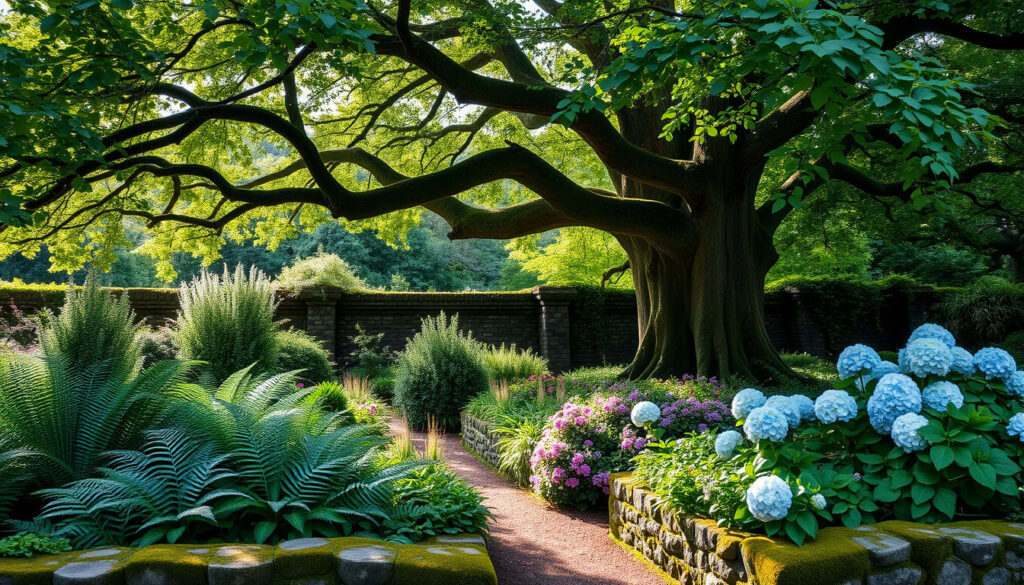
Garden Plants for Shade: Complete Guide for Irish Gardens
Every Irish garden has its awkward corner — the spot behind the shed, the north-facing border, the dark patch under a sycamore — where the sun hardly reaches. The good news is that Ireland’s damp, mild climate is an accidental paradise for shade-loving plants.
Shade types: 3 ·
Min sun (full shade): 0–2 hrs ·
Best-selling perennials (IRE): astilbe, foxglove, pulmonaria ·
Top PAA question: What are the best plants to grow in shade?
Quick snapshot
- Hellebores flower in winter with minimal sun (The Irish Gardener)
- Ferns need no direct sun to thrive (The Irish Gardener)
- October is acceptable for planting hardy perennials in mild Irish/UK climates (Bord Bia)
- Optimal planting depth for some shade seeds in heavy clay
- Exact water needs for shade plants in containers vs. in-ground
- Spring (March-May): Plant shade perennials after last frost (Bord Bia guidance)
- Autumn (September-October): Plant evergreens and hellebores (Bord Bia guidance)
- Plan your shade garden by classifying your light (full, part, dappled)
- Select plants from the categories below matching your light level
- Prepare soil with well-draining potting mix and organic matter
Sorting a shade garden comes down to a handful of decisions. These five facts mark the boundaries between what works and what wastes your time.
| Category | Key Information |
|---|---|
| Shade types | Full shade (0–2 hrs direct sun), Part shade (3–6 hrs), Dappled light |
| Best perennials for full shade | Hellebore, Pulmonaria, Ferns, Ajuga |
| Vegetables for part shade | Lettuce, spinach, kale, beets, carrots |
| October planting | Evergreen ferns, hellebores, spring bulbs (in mild climates) |
| Container success tip | Use well-draining potting mix with organic matter |
What are the best plants to grow in shade?
The answer depends entirely on how much light your spot receives. Irish gardens can split their choices into three broad camps.
Perennials for full shade
- Astilbe produces feathery plumes in moist, low-light borders. The Irish Gardener (expert Peter Dowdall) confirms its reliability in Irish shade gardens.
- Foxglove (Digitalis) tolerates partial to full shade and adds vertical height. The same source lists it among top performers for seasonal interest.
- Pulmonaria (lungwort) is a heavy-shade specialist with spotted foliage that lights up dark corners. The Irish Gardener recommends it for ground cover in shade.
These perennials return year after year, making them the backbone of any low-maintenance full-shade border.
Annuals for partial shade
- Impatiens are the top choice for summer shade containers, producing continuous colour until the first frost. Garden Betty (US gardening blog) lists them among shade-tolerant ornamentals.
- Coleus is prized for its vibrant foliage in low-light containers. It requires warm, frost-free spots.
- Caladium needs warm, shaded spots to develop its striking arrow-shaped leaves.
Annuals offer flexibility: you can swap them out each season to refresh your colour palette.
Foliage plants for deep shade
- Ferns (Polypodium vulgare) need no direct sun and thrive in the damp conditions typical of Irish shade. The Irish Gardener highlights ferns as the default choice under trees.
- Epimedium is a tough ground cover that spreads in dry shade under tree canopies.
- Ajuga reptans forms a dense carpet of purple-tinged leaves, suppressing weeds in full-shade borders.
The implication for Irish gardeners is straightforward: even the darkest corner has a plant that will fill it. The trick is matching the plant’s specific shade tolerance to the hours of light your garden actually gets.
What plants do well in part shade?
Part shade — roughly 3 to 6 hours of sun — is the most forgiving category. A huge range of plants, including edibles, perform well here.
Flowering perennials for dappled light
- Hostas need morning sun and afternoon shade to prevent leaf scorch. The Irish Gardener confirms they are reliable for part shade borders.
- Heuchera (coral bells) grows well in filtered light, offering year-round foliage colour.
- Rhododendrons flourish in part shade with acidic soil, a common match for Irish gardens.
Shrubs for part shade
- Hydrangea and Astrantia provide seasonal flower interest in part shade, according to The Irish Gardener.
Vegetables that tolerate part shade
- Leafy greens (lettuce, spinach, kale, Swiss chard) handle 3–4 hours of sun, as confirmed by Iowa State University Extension (US horticultural authority).
- Root vegetables (beets, carrots, radishes) can grow in dappled light. Greenside Up (Irish gardening resource) adds that dwarf and baby varieties perform best.
- Herbs such as chives, mint, parsley, and coriander thrive in partial shade. Food Garden Life (Canadian gardening site) lists them among the easiest shade-tolerant crops.
What this means: part shade isn’t a limitation — it’s the sweet spot for a huge range of edibles and ornamentals that would struggle in full sun or deep darkness. The Irish climate makes it especially forgiving.
With just 3 to 4 hours of sun, an Irish garden can produce a meaningful vegetable harvest. Iowa State University Extension (US horticultural authority) confirms leafy greens succeed in partial shade, making low-light kitchen gardens a real and reliable option.
What can I plant in full shade in Ireland?
Full shade (0–2 hours of direct sun) is the category that worries most gardeners. In Ireland, it’s a gift: the damp, mild conditions suit plants that hate the heat.
Native Irish shade-lovers
- Wood anemones are native to Irish woodlands and naturalise well under deciduous trees.
- Polypodium vulgare, a common Irish fern, grows on walls, banks, and in deep shade. The Irish Gardener recommends it for north-facing borders.
Hardy perennials for deep shade
- Hellebores flower in winter under tree canopies, providing colour when little else is blooming.
- Fatsia japonica, Aucuba, Sarcococca, and Mahonia are reliable evergreen shrubs for deep Irish shade, according to The Irish Gardener (expert Peter Dowdall).
Ground covers for north-facing borders
- Ivy (Hedera helix) is a robust full-shade ground cover that requires no maintenance.
- Epimedium and Tiarella thrive under trees and form spreading clumps.
The pattern is clear: full shade in Ireland is far from barren. It’s a niche that, once planted correctly, requires less watering and weeding than any sun-drenched border.
What container plants do well in the shade?
Shade containers are a separate challenge from in-ground planting — the soil dries differently, and the plant roots have less space to spread. The right choices make all the difference.
Best low-light container plants
- Impatiens and Coleus are the go-to plants for summer shade pots, offering bright colour without sun demand.
- Caladium needs warm, shaded spots to produce its heart-shaped leaves. Garden Betty (US gardening blog) groups it among reliable low-light ornamentals.
- Ferns are ideal for deep-shade pots, combining texture with year-round structure.
Year-round planting for shade containers
- Carex elata ‘Aurea’ and Stipa arundinacea are recommended by Bord Bia (Ireland’s state food board) for autumn container planting, offering winter interest and movement.
Caring for shaded patio pots
- Use a well-draining potting mix enriched with organic matter. Shade slows evaporation, so overwatering is a bigger risk than underwatering.
- Group pots together to create a microclimate that retains humidity.
- Lift pots on feet or bricks to prevent waterlogging during the wet winter months.
The catch is that containers in shade dry out slower but can become waterlogged. Using a free-draining mix with added organic matter is the difference between success and failure.
Which vegetables grow in shade?
A surprisingly wide range of edibles accept reduced light. The key is matching the crop to the hours of sun your space offers.
Leafy greens for low light
- Spinach, kale, lettuce, and Swiss chard need just 3–4 hours of sun. Iowa State University Extension (US horticultural authority) confirms their viability in partial shade. Arboretum (Irish garden centre) adds that these thrive in Irish shaded gardens.
Root vegetables for part shade
- Beets, carrots, and radishes can grow in dappled light. Greenside Up (Irish gardening resource) recommends baby or early varieties for best results.
Herbs that tolerate shade
- Chives, mint, parsley, coriander, and lemon balm all tolerate partial shade. Food Garden Life (Canadian gardening site) notes that mint-family herbs are particularly resilient in low light.
Fruit in dappled shade
- Currants, gooseberries, blackberries, and raspberries should crop well in dappled woodland conditions, according to Greenside Up (Irish gardening resource).
The trade-off for growing veg in shade is slower growth, but the payoff is less bolting and a longer harvest window. For an Irish kitchen garden, that trade-off often wins.
Is October too late to plant in the shade?
For many Irish gardeners, October feels like the end of the planting season. For shade plants, it’s the ideal window.
Best plants to install in autumn
- Cyclamens, pansies, violas, heucheras, bellis, and primroses are all recommended by Bord Bia (Ireland’s state food board) for October planting in Irish gardens. They grow well in pots, hanging baskets, and garden beds.
- Garlic, leeks, hardy kale, oriental greens, and perpetual spinach are listed by Arboretum (Irish garden centre) as autumn crops ideal for shaded beds.
Planting tips for October shade beds
- Prepare the soil by digging in well-rotted organic matter to improve drainage and nutrient content.
- Plant at the same depth as the nursery pot; firm the soil gently around the roots and water in well.
- Space plants according to their mature size — shade plants often spread wider to capture available light.
Preparing plants for winter in shade gardens
- Mulch heavily after planting to insulate roots from frost. Bark chips or leaf mould work best.
- Avoid summer-flowering bulbs in October — these should be planted in spring.
- Evergreen ferns and hellebores are the most resilient candidates for a winter shade garden.
Why this matters: autumn planting gives roots time to establish before winter, meaning those plants race ahead in spring. October is not a last-minute scramble — it’s a strategic head start.
Shade doesn’t guarantee moisture. Plants under eaves or dense conifers can suffer drought even in Ireland’s wet climate. Check soil moisture by hand — if it’s dry two inches down, water, regardless of how much rain has fallen overhead.
How to plant your shade garden step by step
Step 1: Assess your light levels
- Full shade (0–2 hrs): Under dense trees or north-facing walls. Suitable for ferns, hellebores, Fatsia japonica.
- Part shade (3–6 hrs): Morning or late afternoon sun. Hostas, astilbe, leafy vegetables thrive here.
- Dappled light: Filtered sun through a tree canopy. Woodland plants and fruit bushes perform well.
Step 2: Choose your plants
- Full shade: Ferns, hellebores, Aucuba, Epimedium.
- Part shade: Astilbe, heuchera, rhododendrons, leafy greens.
- Containers: Impatiens, coleus, caladium, Carex elata ‘Aurea’.
Match your plant selection to the light level you measured. For full shade, The Irish Gardener recommends evergreen shrubs like Aucuba and ground covers like Epimedium. For part shade, Iowa State University Extension (US horticultural authority) confirms leafy greens and root vegetables are viable.
Step 3: Prepare the soil
- Dig in organic matter (compost or well-rotted manure) to improve drainage.
- Remove perennial weeds that compete for nutrients and light.
- For containers, use a well-draining potting mix with added organic material.
Step 4: Plant and water correctly
- Plant at the right depth — the crown should sit just above the soil line.
- Water thoroughly after planting to settle the soil.
- Mulch with bark or leaf mould to lock in moisture and suppress weeds.
- Monitor soil moisture — shaded areas can be surprisingly dry under dense tree canopies.
The takeaway: a shade garden in Ireland is built in autumn, not spring. The plants that go in now will be the ones that thrive next year.
Irish gardeners trading full sun for full shade gain time: less watering, less weeding, and plants that won’t bolt in a heatwave. The catch is slower growth in spring, but a well-planned autumn planting — backed by Bord Bia (Ireland’s state food board)’s October recommendations — erases that gap entirely.
Shade Gardening: What’s Settled and What’s Still Open
Confirmed facts
- Hellebores flower in winter with minimal sun. The Irish Gardener confirms they are a reliable winter performer under tree canopies.
- Ferns need no direct sun to thrive. The Irish Gardener lists ferns as the default choice for deep shade.
- Leafy greens need only 3–4 hours of sun. Iowa State University Extension (US horticultural authority) confirms this threshold for part-shade vegetables.
- October is a viable planting window for hardy perennials in Ireland. Bord Bia (Ireland’s state food board) recommends October planting for cyclamens, pansies, and evergreens.
What’s unclear
- Optimal planting depth for certain shade seeds in heavy clay soil. Standard depths are given, but heavy clay can alter germination and root development.
- Exact water needs for shade plants in containers vs. in-ground under Irish rainfall patterns. Shade slows evaporation, but tree canopies can block rainfall, making generalizations unreliable.
- Whether all astilbe varieties tolerate the same degree of dryness in deep soil. Performance may vary between cultivars.
- Specific overwintering success rates for new shade perennials planted in October across different Irish hardiness zones. Mild coastal areas differ from inland frost pockets.
- The long-term performance of non-native evergreen shade shrubs (Fatsia japonica, Aucuba) in exposed coastal gardens. Wind tolerance is less documented than shade tolerance.
Expert Perspectives on Shade Gardening in Ireland
“Fatsia japonica, Aucuba, Sarcococca, and Mahonia are reliable evergreens for deep shade in Ireland.”
— The Irish Gardener (expert Peter Dowdall)
“October is a good month to plant cyclamens, pansies, violas, heucheras, bellis, and primroses in Irish gardens.”
— Bord Bia (Ireland’s state food board)
“Leafy vegetables such as kale, cabbage, Swiss chard, spinach, and lettuce are suitable for gardens that are shady on and off throughout the day.”
— Greenside Up (Irish gardening resource)
“Leafy vegetables can be successfully grown with 3 to 4 hours of sun.”
— Iowa State University Extension (US horticultural authority)
The old instinct to curse a shaded border is exactly backwards for Irish gardens. The real missed opportunity is spending another year trying to force sun-lovers into a spot they can’t handle. Pick the right shade plants — the ones backed by Bord Bia, the Irish Gardener, and Greenside Up — plant them at the right time, and that awkward corner becomes the most resilient, lowest-maintenance part of your garden. For the Irish gardener, the only wrong move is ignoring what the shade is telling you.
daintydressdiaries.com, youtube.com, youtube.com, gardenersworld.com, connectingtonature.ie
For Irish gardeners seeking specific varieties, ordering shade-loving plants online from specialist nurseries can be a convenient alternative to local garden centres.
Frequently asked questions
Can hydrangeas grow in full shade?
Hydrangeas prefer part shade (morning sun, afternoon shade). In full shade they will produce fewer flowers. The Irish Gardener lists them as a plant for seasonal flower interest in shaded conditions, implying they are not full-shade specialists.
Do ferns need any sunlight at all?
Ferns are among the few plants that need no direct sun to thrive. They perform best in full shade under tree canopies or on north-facing borders. The Irish Gardener confirms ferns thrive under trees.
How much water do shade plants need?
Shade plants generally need less frequent watering than full-sun plants because evaporation is slower. However, plants under dense tree canopies may not receive rainfall, so monitoring soil moisture is important. Use well-draining potting soil to avoid root rot.
What ground covers are best for dry shade?
Dry shade is a challenge under trees and hedges that absorb moisture. Ajuga reptans, Epimedium, and Ivy (Hedera helix) are robust options for dry shade. The Irish Gardener recommends ferns and Epimedium for under trees.
Are there evergreen plants for shade in Ireland?
Yes. Fatsia japonica, Aucuba japonica, Sarcococca, and Mahonia are reliable broadleaf evergreens for deep shade in Ireland. The Irish Gardener lists these as dependable choices that maintain structure year-round.
Can you grow shade plants in clay soil?
Yes, but amending clay soil with organic matter is essential to improve drainage. Pulmonaria, hostas, and astilbe are shade plants tolerant of heavier soils. Bord Bia emphasizes soil preparation for autumn planting success.
What is the best mulch for shade gardens?
Organic mulches like well-rotted leaf mould, bark chips, or garden compost work best. They mimic the natural forest floor and help retain moisture while slowly feeding the soil. Apply a 5–7 cm layer in autumn to protect roots.
How do I prepare soil for a shade border?
Dig in plenty of organic matter (compost, well-rotted manure) to improve moisture retention and drainage. Remove perennial weeds. A pH test can help; many shade plants (rhododendrons, heucheras) prefer slightly acidic soil.
More related posts
 Best Places to Work From: Ireland Salary, Rules & Spots
 The George Hotel Christchurch: Boutique Luxury Guide
 Gluten Free Hot Cross Buns: Buy at Aldi, Tesco, M&S
 EB Games New Plymouth Closing January 2025
 Del Mar Shark Attack 2024: Facts, Reopening & History
 What Is an Executive Summary – Definition, Purpose and Examples
 Logan Brown Menu Guide: Dishes, Degustation & More
 Princess Margaret, Countess of Snowdon: Key Facts