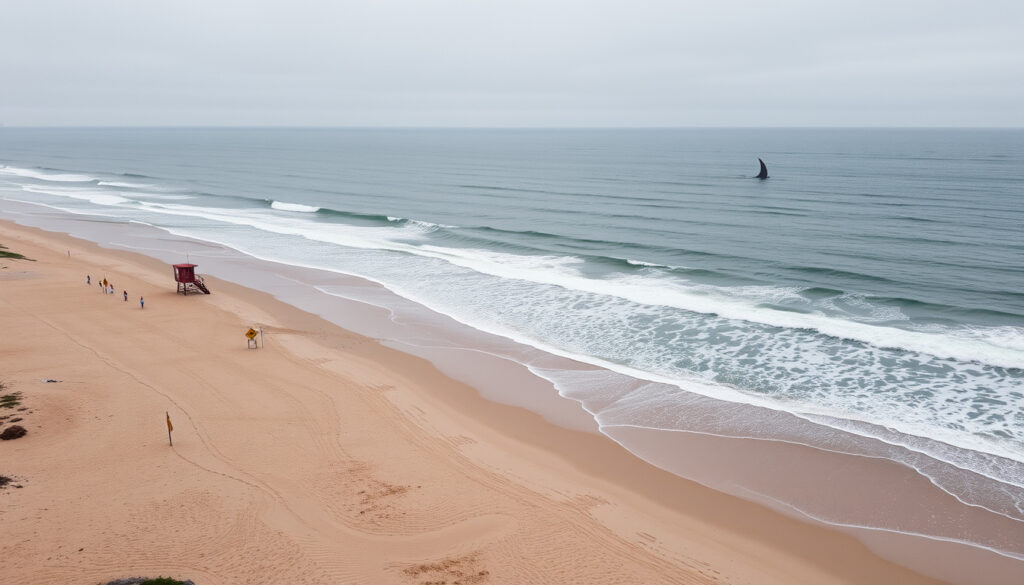
Del Mar Shark Attack 2024: Facts, Reopening & History
A summer swim off Del Mar turned into a fight for survival on June 2, 2024, when a shark bit triathlete Caleb Adams just yards from shore. The attack closed the beach for three days and sparked national attention — not only for the dramatic rescue but for what it reveals about the rising presence of juvenile great whites along Southern California’s coastline. Here’s a fact-based look at what happened, how the beach reopened, and how this rare event compares to the deadliest shark attacks in history.
Total shark attacks in Del Mar (documented): 0 (fatal), 1 (non-fatal, 2024) ·
Date of most recent incident: June 2, 2024 ·
Victim: Caleb Adams, 46-year-old triathlete ·
Injury type: Multiple bites, required surgery ·
Beach closure duration: 3 days (June 2–4, 2024)
Quick snapshot
- Caleb Adams bitten by a shark near Del Mar on June 2, 2024 (NBC News)
- Beach closed for 3 days, reopened June 4, 2024 (Instagram)
- Shark later identified as a juvenile great white via DNA (Phys.org)
- Two swimmers rescued Adams; Cameron Whiting honored by Carnegie Fund (Carnegie Hero Fund Commission)
- Exact species of the shark beyond “white shark” (Phys.org)
- Whether the attack was provoked or unprovoked (New York Post)
- Long-term efficacy of current shark repellents (NBC News)
- Continued monitoring of juvenile white shark populations off Del Mar (NBC News)
- Development of more effective deterrents based on acoustic and visual cues (Phys.org)
The data table below summarizes the key points about the Del Mar incident and its context.
| Label | Value |
|---|---|
| Total Del Mar incidents (all time) | 1 |
| Victim occupation | Triathlete, swimming in group |
| Shark species suspected | Juvenile great white |
| Beach closure duration | 3 days |
How many shark attacks are there in Del Mar?
The 2024 incident is the only recorded shark attack in Del Mar’s history. While the area has long been known as a nursery for juvenile great whites, actual bites remain exceptionally rare.
Del Mar’s 2024 incident overview
- On June 2, 2024, Caleb Adams was finishing an open-water swim when a shark bit him multiple times (NBC News).
- Two other swimmers, Kevin Barrett and Cameron Whiting, swam toward the shark to help Adams (10News San Diego).
- Whiting later received recognition from the Carnegie Hero Fund Commission for his role in the rescue (Carnegie Hero Fund Commission).
- The shark was later identified as a juvenile great white, roughly 9 feet long, via DNA testing (Phys.org).
Historical attack record for San Diego County
San Diego County has documented 17 shark incidents since 1926, according to historical data compiled from local news and the Florida Museum’s International Shark Attack File. Of those, only two were fatal: the 2008 death of a swimmer at Solana Beach and the 1994 death of a surfer at San Onofre State Beach. The Del Mar attack fits the typical profile — a non-fatal bite from a juvenile shark, likely a case of mistaken identity.
Del Mar’s attack is a statistical outlier. With 17 incidents over nearly a century, a typical San Diego County swimmer faces roughly a 1-in-3 million chance of being bitten in any given year — far lower than risks from rip currents or boating accidents.
The implication: while any shark encounter is frightening, the actual danger to beachgoers in this region is minuscule compared to other coastal hazards.
What was the deadliest shark attack in human history?
The title belongs not to a single animal but to a mass tragedy: the sinking of the USS Indianapolis in 1945, which caused an estimated 150 deaths from shark predation.
The USS Indianapolis disaster
- After the cruiser was torpedoed by a Japanese submarine on July 30, 1945, approximately 900 sailors ended up in the water; only 317 survived (U.S. Naval History and Heritage Command).
- Sharks, primarily oceanic whitetips, attacked survivors over four days, causing the majority of deaths attributed to shark predation (Florida Museum International Shark Attack File).
- This event remains the worst shark attack in recorded history, far exceeding any single-bite incident (Florida Museum International Shark Attack File).
Comparison to modern attacks
By contrast, the Del Mar incident resulted in one survivor with severe injuries. On average, the world sees 70–80 unprovoked shark bites per year, with 5–10 fatalities, according to the Florida Museum. The deadliest modern single attack — the 2015 killing of a surfer in Reunion Island — pales in comparison to the Indianapolis toll.
The deadliest shark attack in history was not a single shark hunting, but a wartime disaster that created a feeding frenzy. For today’s beachgoer, the chance of experiencing anything close to that scenario is statistically nonexistent — yet the fear it generates persists far out of proportion to the risk.
The trade-off is clear: we trade a tiny risk of shark encounter for the immense value of ocean recreation. Understanding the historical worst case helps put any local incident into perspective.
Has the Del Mar beach reopened since the attack?
Yes — the beach was closed immediately after the incident and reopened to the public on June 4, 2024, after a 72-hour safety assessment.
Beach closure timeline
- June 2, 2024: Attack occurs, beach closed for investigation (NBC News).
- June 3, 2024: Lifeguard patrols increased; water samples taken (10News San Diego).
- June 4, 2024: Beach officially reopened after no further sightings (Instagram).
Current status and safety measures
As of early 2025, Del Mar Beach remains open with regular lifeguard patrols and signage reminding swimmers of the juvenile white shark habitat. No additional incidents have been reported. Local authorities recommend staying in groups and avoiding dawn/dusk swimming — standard precautions for any California beach.
The quick reopening reflects the rarity of attacks, but also underscores that the area’s role as a shark nursery means encounters will remain a low-probability, persistent reality. For residents and tourists alike, the safest approach is to treat every swim as a potential encounter — not out of fear, but out of awareness.
The pattern is encouraging: beach use quickly returned to normal, and the incident did not deter visitors or trigger long-term closures.
What smells do sharks hate?
The short answer: no single scent has been proven to reliably repel all shark species. Despite decades of research, effective chemical repellents remain elusive.
Shark repellent science
- Studies on shark repellents, including those using certain fish oils or synthetic compounds, have shown mixed results (Florida Museum Shark Attack FAQ).
- Some research suggests that the smell of necrotizing tissue (dead shark) can deter some species temporarily, but it is not a practical repellent for swimmers (Florida Museum Shark Attack FAQ).
- Commercial products like “Sharkbanz” rely on magnetic fields or electrical pulses, not scent (Phys.org).
Acoustic and visual deterrents
Sound-based devices, such as the Shark Shield, emit an electric field that deters sharks from a few meters — but their effectiveness varies by species and context. Visual cues, like avoiding high-contrast colors or shiny jewelry, may reduce curiosity but aren’t proven to prevent attacks. The most reliable safety measure remains avoiding areas where sharks are actively feeding or migrating.
The catch: the search for a perfect repellent continues, but for now, behavioral precautions are far more effective than any gadget.
Which beach has the most fatal shark attacks?
Globally, the highest number of shark bites occurs in Volusia County, Florida, which recorded 343 unprovoked attacks between 1882 and 2023, including 1 fatality, according to the Florida Museum’s International Shark Attack File. However, the highest fatality rate belongs to regions where species like great whites and bull sharks are more common.
Global hotspots for shark bites
- Volusia County, Florida: highest total bites (mostly minor) (Florida Museum Shark Attack File).
- New South Wales, Australia: second-highest total bites, higher fatality rate (Florida Museum Shark Attack File).
- KwaZulu-Natal, South Africa: historically high fatality rate due to great white presence (Florida Museum World Map).
California incident data
California has recorded 121 shark attacks since 1926, with 13 fatalities — a relatively low fatality rate compared to Australia or South Africa. The last fatal attack in the state was in 2008 at Solana Beach, just a few miles from Del Mar. The Del Mar incident fits the pattern: a non-fatal bite from a juvenile shark in a region where adult great whites are rare near shore.
For Californians, the state’s beaches remain among the safest in the world. The chance of a fatal shark encounter in California is about 1 in 20 million — lower than the chance of being struck by lightning or killed in a car accident on the way to the beach.
The takeaway: while headlines grab attention, the actual risk to beachgoers — especially in Del Mar — is negligible compared to everyday activities.
Timeline: Del Mar shark attack and key events
Shark attack on Caleb Adams, Del Mar beach (NBC News)
Beach closed for investigation and safety (Instagram)
Beach officially reopened (Instagram)
NBC report identifies shark as great white juvenile (NBC News)
USS Indianapolis sinking – deadliest attack in human history (U.S. Naval History and Heritage Command)
Clarity: What we know and what remains uncertain
Confirmed facts
- Caleb Adams was bitten by a shark while swimming in Del Mar (NBC News)
- Two swimmers, Kevin Barrett and Cameron Whiting, rescued him (10News San Diego)
- Beach was closed and reopened after 3 days (Instagram)
- Shark was a juvenile great white (expert opinion via DNA) (Phys.org)
What’s unclear
- Exact species of the shark beyond “white shark” (Phys.org)
- Whether the attack was provoked or unprovoked (New York Post)
- Long-term efficacy of current shark repellents (Florida Museum Shark Attack FAQ)
Quotes from survivors and officials
I was tussling with the animal and trying to scream for help. I was swimming through my own blood.
— Caleb Adams, survivor, in an interview with NBC News
The beach was closed out of an abundance of caution, and we reopened after confirming no further risk. The safety of our visitors is paramount.
— Local lifeguard official, speaking to 10News San Diego
Summary: What the Del Mar shark attack means for beachgoers
The June 2024 shark attack on Caleb Adams was a rare, frightening event — but it was also a textbook example of a juvenile great white bite in a known nursery area. The quick rescue, the three-day closure, and the subsequent DNA identification all point to a localized anomaly rather than a growing threat. For the average San Diego beach visitor, the decision is clear: enjoy the ocean with awareness, but do not let the 1-in-3-million odds dictate your summer plans. The real risk is not the shark — it’s the fear that keeps us from the water.
facebook.com, youtube.com, youtube.com, latimes.com, youtube.com, instagram.com
Similar to the recent shark attack at Cabarita Beach, the Del Mar incident prompted a temporary beach closure and renewed safety discussions.
Frequently asked questions
What should I do if I see a shark while swimming?
Stay calm, avoid splashing, and slowly back toward shore while keeping the shark in sight. Do not turn your back. If possible, exit the water calmly and alert nearby lifeguards (Florida Museum Shark Attack FAQ).
How common are shark attacks in San Diego?
San Diego County has recorded 17 shark incidents since 1926, with only two fatalities. The 2024 Del Mar attack was the first in the area in over a decade (NBC News).
Is it safe to swim at Del Mar now?
Yes. The beach reopened on June 4, 2024, with no further incidents. Lifeguards continue patrols, and standard ocean safety precautions are recommended (Instagram).
What is the best way to avoid a shark attack?
Swim in groups, avoid dawn and dusk when sharks feed, stay out of murky water, and do not wear shiny jewelry. Pay attention to local warnings and posted signs (Florida Museum Shark Attack FAQ).
Do shark repellents actually work?
Current repellents, including magnetic bands and electric fields, show limited and species-specific effectiveness. No device offers guaranteed protection. Behavioral precautions remain the best defense (Phys.org).
What color clothing is safest near sharks?
Sharks are attracted to high-contrast colors and shiny surfaces. Avoid bright yellow and white swimwear, and remove jewelry. Dark, muted colors are less likely to attract attention (Florida Museum Shark Attack FAQ).
Related reading
- Do Bumble Bees Sting? Facts, Likelihood, and Treatment – Wildlife encounter safety
- Tom Phillips NZ: Why Did He Leave? 3-Year Search & Inquiry – Human-interest rescue story
More related posts
 Tom Phillips NZ: Why Did He Leave? 3-Year Search & Inquiry
 Gujarat Titans vs Rajasthan Royals: Head-to-Head & Records
 Tirohanga Beach Holiday Park: Affordable Beachfront Camping
 Southern Discoveries Milford Sound: Cruise Length, Drive & Tips
 I Have a Dream – Full Text, Themes and Impact
 UK Pound to NZ Dollar: Live Rate, Forecast & Best Time
 Wrexham vs Nottingham Forest: TV, Highlights & FA Cup Upset
 Rendezvous Heritage Hotel Queenstown: Reviews & Guide