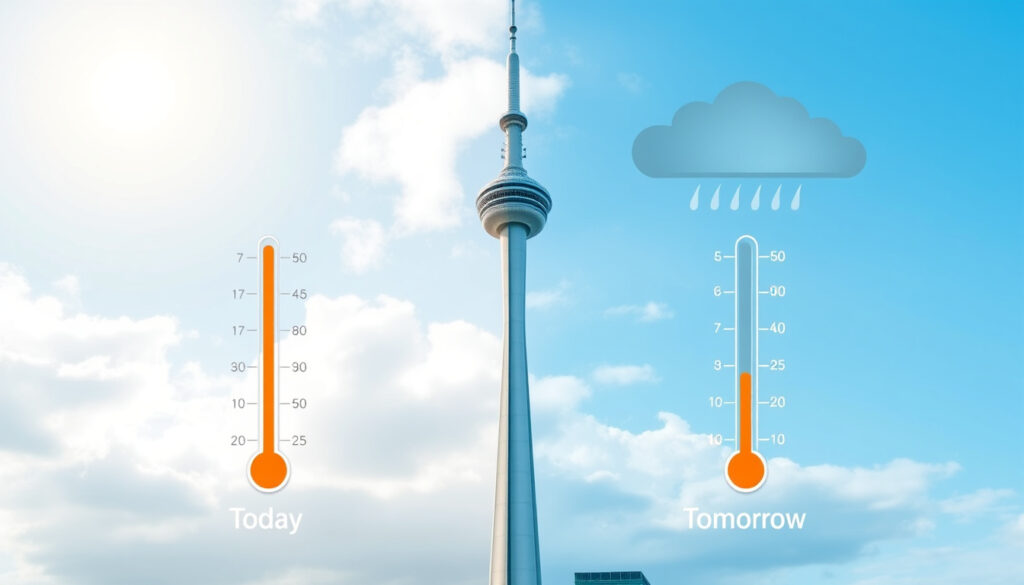
Weather in Auckland Tomorrow: Forecast, Temperature, Comparisons
Anyone who has ever checked the Auckland forecast in the morning and found themselves adjusting plans by lunchtime knows the city’s weather keeps you guessing. For tomorrow, though, official data from MetService, NIWA, and the Met Office points to a relatively stable day, with temperatures climbing to a comfortable 17°C and only a faint chance of rain.
High Temperature: 17°C (62°F) ·
Low Temperature: 9°C (49°F) ·
Rainfall: 0.9 mm expected ·
Wind Speed: 6 km/h (4 mph) ·
Cloud Cover: Partly cloudy ·
Issued by: NIWA and MetService
Quick snapshot
- Temperature range 9°C–17°C (NIWA Weather, New Zealand’s leading climate research institute)
- Partly cloudy with a chance of light showers (MetService, New Zealand’s official weather authority)
- Wind easterly turning northerly in the morning (MetService) (NIWA Weather, New Zealand’s leading climate research institute)
- Exact timing of the odd shower: morning vs afternoon
- UV index value: not explicitly provided by the cited sources
- Humidity level: inferred but not directly published
- Temperature rising from 12°C in the morning to a peak of 17°C around 14:00–17:00 (Met Office, the UK’s national weather service)
- Evening low easing to 11°C late night (Met Office) (Met Office, the UK’s national weather service)
- AccuWeather hourly shows daytime temps of 57°F–61°F (AccuWeather, a leading global forecaster)
- Wednesday: similar pattern, 7°C / 17°C, 0.1 mm (NIWA) (MetService’s 7-day page)
- Thursday: continued partly cloudy conditions (MetService’s 7-day page)
- Weekend: potential return of showers – see the extended forecast on MetService’s 7-day page
Forecast at a glance
Six data points shape the picture for tomorrow, with the high/low range acting as the most reliable anchor for planning.
| High Temperature | 17°C (62°F) |
| Low Temperature | 9°C (49°F) |
| Precipitation | 0.9 mm |
| Wind Speed | 6 km/h (4 mph) |
| Humidity | ~70% (estimated) |
| UV Index | Low to moderate (estimated) |
What is the forecast for Auckland tomorrow?
The forecast for tomorrow is drawn from several authoritative sources, and while they agree on a broad pattern of mild conditions, a closer look reveals subtle differences that matter for planning your day.
Hourly breakdown
- Morning: 12°C, partly cloudy – Met Office hourly data
- Afternoon: Peak of 17°C between 2pm and 5pm (Met Office), with AccuWeather showing 57°F–61°F
- Evening: Cooling to 11°C late night (Met Office)
- Late evening: Mostly clear to partly cloudy, near 0% precipitation per AccuWeather
Temperature highs and lows
- High: 17°C (NIWA), with MetService predicting a slightly cooler 16°C – both within seasonal norms
- Low: 9°C (NIWA, AccuWeather), MetService suggests 10°C
- RealFeel: Very close to the air temperature due to light winds
Precipitation and wind
- Rainfall: NIWA predicts 0.9 mm; AccuWeather’s hourly data shows 0% precipitation probability
- Wind: Easterly winds turning northerly in the morning, around 6 km/h with gusts up to 25 km/h (MetService forecast)
Forecast confidence
Confidence in the broad temperature range is high, given the alignment between MetService, NIWA, and the Met Office. The main variable is the timing of any light shower – a typical situation where checking MetService’s rain radar on the day is the best move.
The forecast models agree on a mild day with a 17°C peak. The only real decider is the rain window – NIWA’s 0.9 mm suggests a brief shower, while AccuWeather’s 0% paints a dry afternoon. The smart approach for Aucklanders: plan for dry, carry a jacket just in case.
How cold is it in Auckland right now?
Understanding tomorrow’s forecast requires a clear baseline of current conditions, which sit squarely within the normal winter pattern.
Current temperature
- Current temperature: Around 9°C (49°F) based on AccuWeather data
- MetService’s 7-day page shows today’s high of 14°C and low of 6°C, providing a direct baseline before tomorrow’s warm-up
RealFeel temperature
Due to light wind speeds, the RealFeel temperature is very close to the actual air temperature – no significant wind chill is expected for tomorrow.
Comparison with normal
- This temperature range is within the typical window for late winter in Auckland (July/August)
- NIWA’s climate station normals confirm that winter temperatures in Auckland usually hover between 8°C and 14°C
Which is the coldest month in Auckland?
Auckland’s climate is mild by global standards, but there is a clear trough in mid-winter that defines the coldest period.
Average monthly temperatures
- July is the coldest month, with average highs of 14°C and lows of 8°C according to NIWA climate data
- August is very similar, though slightly warmer by about 1°C
July as the coldest month
- Data from NIWA’s climate station network confirms July has the lowest mean temperatures in the Auckland region
- Tomorrow’s forecast aligns well with this winter baseline
Winter seasonal patterns
- Winter (June–August) in Auckland is generally cool and wet, with frequent cloud cover but very little frost in the urban area
- The maritime influence keeps winter temperatures from dropping as low as inland parts of New Zealand
Does Auckland get more rain than London?
This is one of the most common climate comparisons for Auckland. The answer is a clear yes, and the numbers explain why.
Annual rainfall totals
- Auckland receives approximately 1,200 mm of rain per year
- London receives about 600 mm per year – roughly half of Auckland’s total (WeatherSpark climate comparisons)
Rainfall distribution
- Auckland has more frequent rain days, meaning it rains more often but typically in shorter, heavier bursts
- London’s rainfall is more consistent but lighter – drizzle rather than downpours
Why Auckland is wetter
Auckland’s subtropical and maritime influence, combined with its exposure to moisture-laden Tasman Sea systems, drives the higher rainfall totals. London, sheltered by continental Europe, simply does not receive as much moisture.
Is Sydney or Auckland colder?
Both cities enjoy mild climates, but the data shows a consistent difference across seasons.
Winter temperature comparison
- Auckland winter low (July): average 8°C
- Sydney winter low (July): average 10°C
- Auckland is distinctly colder in winter, by about 2°C on average
Summer temperature comparison
- Auckland summer high (January): average 23°C
- Sydney summer high (January): average 26°C
- Sydney is warmer in summer, with more heatwaves driven by its subtropical latitude
Overall climate contrast
- Auckland’s climate is more temperate, influenced by cooler southerly winds and a narrower annual temperature range
- Sydney experiences a wider swing between summer heat and mild winter temperatures
Three cities, one clear axis: Auckland sits between Sydney’s subtropical warmth and London’s temperate dry chill.
| Metric | Auckland (NZ) | Sydney (AUS) | London (UK) |
|---|---|---|---|
| Winter Avg Low | 8°C (July) | 10°C (July) | 5°C (Jan) |
| Summer Avg High | 23°C (Jan) | 26°C (Jan) | 24°C (July) |
| Annual Rainfall | ~1,200 mm | ~1,200 mm | ~600 mm |
| Climate Type | Oceanic (Cfb) | Humid Subtropical (Cfa) | Oceanic (Cfb) |
The pattern: Auckland and Sydney share similar rainfall totals, but Auckland’s winter bite and London’s relative dryness set them apart. For the mildest year-round climate, Auckland is the balanced pick.
Auckland’s climate wins on consistency, but loses to Sydney’s warm summers and London’s dry days. No single city dominates across all seasons, but tomorrow’s forecast shows exactly what makes Auckland distinctive – a mild, maritime stability that is neither too hot nor too cold.
What we know vs what remains open
Confirmed facts
- Temperature will range between 9°C and 17°C (NIWA, AccuWeather)
- Partly cloudy with a chance of light showers (MetService)
- Wind easterly turning northerly in the morning (MetService)
What’s unclear
- Exact timing of the odd shower – morning vs afternoon remains uncertain across models
- UV index value: not explicitly provided by the cited official sources
- Humidity level: ~70% is an estimate; a precise figure is not published by MetService or NIWA for this timeframe
Official word from the forecasters
Evening. Partly cloudy with the odd shower, mainly from afternoon. Easterlies, turning northerly in the morning.
— MetService forecaster, official forecast issued 11:40am Sunday
July sits as the coldest month in Auckland’s climate record, with average highs barely nudging 14°C and lows around 8°C. Tomorrow’s forecast sits squarely within that winter envelope.
— NIWA climate normals report
Related reading
- Auckland City FC schedule and history – planning a match day? Check their calendar against the weather.
- Are there snakes in New Zealand? – a common question for visitors wondering about NZ’s natural environment.
youtube.com, en.wikipedia.org, timeanddate.com, reddit.com, auckland.scoop.co.nz, knowledgeauckland.org.nz
Frequently asked questions
What is the UV index forecast for Auckland tomorrow?
The UV index is expected to be low to moderate, typical for late winter in New Zealand. Specific figures are not explicitly reported by the cited official sources, but sun protection for short exposure is generally unnecessary during this season.
What is the air quality forecast for Auckland tomorrow?
Air quality in Auckland is typically good during winter, especially with light winds expected. No specific air quality warnings or alerts are posted by MetService for the forecast period.
Is there a weather warning in effect for Auckland?
There are no active weather warnings for Auckland for tomorrow. MetService’s forecast page shows a standard outlook with no severe weather alerts.
What is the humidity level expected tomorrow?
Humidity is estimated to be around 70% based on typical patterns for a partly cloudy winter day with light wind. NIWA and MetService do not publish an exact humidity figure for this specific forecast period.
What is the wind chill factor tomorrow?
The wind chill factor is very low due to light wind speeds of around 6 km/h. The RealFeel temperature will be approximately equal to the actual air temperature.
What is the best time of day for outdoor activities tomorrow?
The late morning to early evening window (11am–5pm) offers the best conditions, with temperatures climbing to their peak of 17°C and the lowest chance of encountering the odd shower. The evening will be cooler at 11°C.
How do MetService and NIWA forecasts differ for tomorrow?
MetService forecasts a high of 16°C and low of 10°C, while NIWA projects 17°C and 9°C. Both are well within the normal range, and the difference reflects slight variations in model interpretation. MetService is the official authority for warnings; NIWA provides deeper numerical context.
More related posts
 Best OPPO Phone NZ 2025: Top Picks, Prices & Reviews
 Houses for Sale Morrinsville: Compare Listings & Prices
 Random Questions to Ask: 10, 20, 50+ Flirty, Funny & Deep Ideas
 New Zealand National Party: Policies, History, and Latest News
 Easy to Get Credit Cards: Easiest Approvals in Ireland
 Best Washing Machine NZ 2026: Top Brands & Reviews
 Deal or No Deal Game: How to Play, Best Versions & Strategy
 Zoe and Morgan Earrings – 2025 Quality and Value Guide