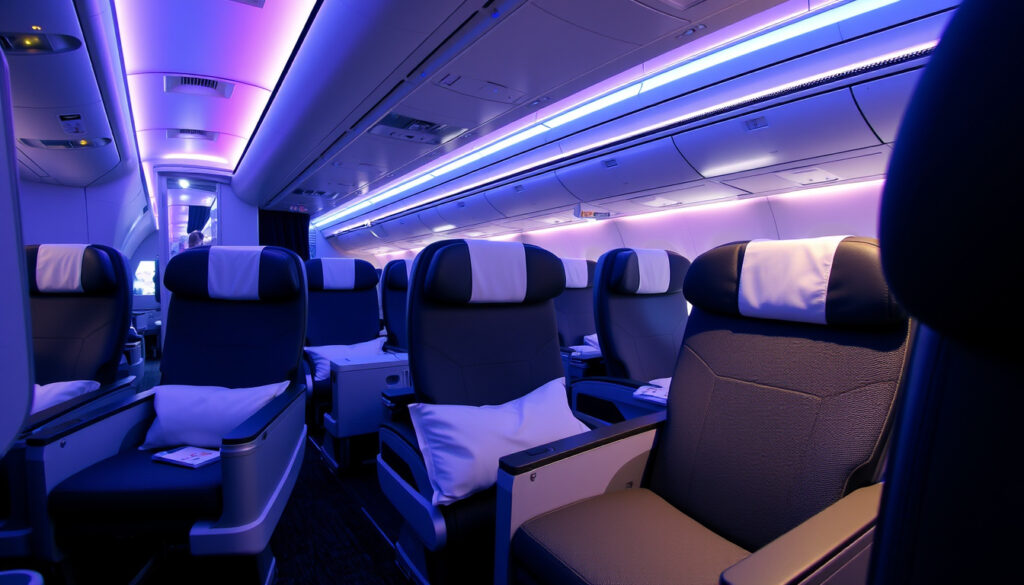
Air New Zealand 787-9 Guide: Seats, Retrofit & More
Picking a seat on a long-haul flight can feel like a game of luck — especially when the plane you’re booking has multiple interior versions, but Air New Zealand is overhauling all 14 of its Boeing 787-9 Dreamliners with a completely redesigned cabin, starting early 2025. This guide breaks down the retrofit timeline, the best seats on both old and new layouts, and the safety history behind this wide-body workhorse.
Fleet size: 14 aircraft ·
Standard seat count: 302 (older configuration) ·
New premium seat count: 219 ·
Retrofit target: Entire fleet by mid-2026
Quick snapshot
- Boeing 787-9 Dreamliner, 14 in the Air New Zealand fleet (Air New Zealand Newsroom)
- Full retrofit program underway from early 2025 (Air New Zealand Newsroom)
- Business Premier: 26 lie-flat seats in 1-2-1 layout (The Up Front)
- Premium Economy: 33 seats, 41-inch pitch (Air New Zealand seat map)
- Economy: 213 seats, 31-32 inch pitch (Air New Zealand seat map)
- First retrofitted aircraft flew on May 19, 2025 (Air New Zealand Newsroom)
- All 14 787-9s scheduled for retrofit by end of 2026 (Air New Zealand Newsroom)
- Use Air New Zealand’s official V3 seat map for retrofitted aircraft (Air New Zealand seat map)
- Premium rows 1-3: Business Premier Luxe and standard Business Premier (Air New Zealand seat map)
- Economy Stretch rows 36 offer 35-inch pitch (Air New Zealand seat map)
Six key specs define the Air New Zealand 787-9, with the retrofit reshaping seat counts and pitch.
| Specification | Value |
|---|---|
| Aircraft type | Boeing 787-9 (Air New Zealand Newsroom) |
| Fleet size | 14 aircraft (Air New Zealand Newsroom) |
| Business Premier seats | 26 (The Up Front) |
| Premium Economy seats | 33 (The Up Front) |
| Economy seats | 213 (The Up Front) |
| Economy seat pitch | 31–32 in (Air New Zealand seat map) |
What is the 787-9 Dreamliner Air New Zealand?
Overview of the Air New Zealand 787-9 fleet
- Air New Zealand operates 14 Boeing 787-9 aircraft, all part of a multi-year retrofit program (Air New Zealand Newsroom)
- The fleet includes multiple seat-map versions — V1, V2, V3, and V4 — meaning passengers may encounter different interiors depending on the aircraft (SeatMaps)
The implication: booking a seat on the 787-9 isn’t a one-size-fits-all experience. Knowing which version you’re on matters more than ever.
Design and cabin features
- The new cabin introduces 50% larger inflight entertainment screens and expanded storage options in Economy (Air New Zealand Newsroom)
- Premium Economy now uses a fixed outer shell so recline does not disturb the passenger behind (Air New Zealand Newsroom)
Why this matters: these aren’t minor tweaks — the redesign fundamentally changes the feel of the cabin, especially for passengers in the back who get bigger screens and better stowage.
Is the Boeing 787-9 a good plane?
Passenger comfort and reviews
- The 787-9’s lower cabin altitude (6,500 ft vs 8,000 ft on older planes) and larger windows help reduce jet lag (Wikipedia)
- Retrofitted Air New Zealand 787-9s offer 1-2-1 Business Premier seating, a significant upgrade from the previous herringbone layout (YouTube review)
The catch: while the new business seats are a clear win, passengers on non-retrofitted aircraft still face the older configuration — so check the aircraft version when booking.
Performance and efficiency
- The 787-9 burns about 20% less fuel per seat than the 777 it replaces, according to Boeing (Boeing)
- Rolls-Royce Trent 1000 engines power the Air New Zealand fleet, with a dispatch reliability above 99% since modifications after the 2013 grounding (Wikipedia, Boeing 787 Dreamliner)
The trade-off: better fuel efficiency and range come with a complex battery system that required a redesign after the 2013 incidents — more on that below.
How many 787-9 Dreamliners are Air NZ having retrofitted?
Retrofit timeline and scope
- All 14 787-9s will be updated to the new cabin layout (Air New Zealand Newsroom)
- The first retrofitted aircraft, ZK-NZH, entered passenger service on May 19, 2025 (Air New Zealand Newsroom)
- Seven planes are expected to be completed by the end of 2025; the second aircraft is already undergoing retrofit in Singapore (Air New Zealand Newsroom)
The 219-seat “premium” layout targets long-haul routes, while older 302-seat configurations may still appear on shorter sectors. Always check the seat map at booking.
New cabin experience details
The retrofitted cabin adds Business Premier Luxe seats in row 1 and row 9, offering extra privacy and space (Air New Zealand seat map). Premium Economy retains its 41-inch pitch while gaining the fixed-shell recline. Economy passengers get 50% larger IFE screens and “Economy Stretch” rows with 35-inch pitch on the V3 map.
The pattern: the new cabin is a significant upgrade, but passengers on non-retrofitted aircraft will still experience the older configuration until the transition is complete.
What are the best seats on an Air NZ 787-9?
Best seats in Business Premier
- Row 1 and row 9 feature Business Premier Luxe — larger suites with extra privacy (Air New Zealand seat map)
- Rows 2–7 and 10–12 are standard Business Premier with direct aisle access in 1-2-1 layout
Best seats in Premium Economy
- Rows 23–30 provide 41-inch pitch and the new fixed-shell seat (Air New Zealand seat map)
- Front rows (23) typically have no recline restriction from bulkheads, but check seat map for galley proximity
Best seats in Economy
- Economy Stretch (35-inch pitch) is available in row 36 ABC and rows 36–40 HJK (Air New Zealand seat map)
- Economy Skycouch rows (37–39 ABC, 41–46 HJK) allow turning three seats into a flat zone for sleeping (Air New Zealand seat map)
- Avoid rows directly adjacent to lavatories (usually rows 34 and 47 on V3 map)
Using seat maps
Always consult Air New Zealand’s official interactive seat map (Air New Zealand seat map) before booking. Third-party tools like SeatGuru (SeatGuru) can supplement, but only the airline’s map reflects the exact retrofit status.
The takeaway: careful seat selection is essential during the retrofit period.
What is the 787-9 Dreamliner controversy?
Battery issues and grounding history
- In 2013, lithium-ion battery fires on two separate 787s led to a worldwide grounding of the entire Dreamliner fleet (Wikipedia)
- Boeing redesigned the battery system with improved containment, venting, and monitoring; FAA approved the fix in April 2014 (FAA)
- No battery-related incidents have occurred since the redesigned system was implemented
Recent concerns and safety record
- Since 2014, the 787-9 has accumulated an excellent dispatch reliability record, exceeding 99% (Wikipedia)
- Air New Zealand has not experienced any major 787 incidents; its fleet is considered among the best-maintained in the industry (Air New Zealand Newsroom)
The pattern: the 2013 controversy was a genuine crisis, but the aircraft has since become one of the safest and most efficient widebodies. Passengers who worry about the 787’s early history can rest easy — the fixes worked.
Three key differences separate the old 302-seat layout from the new 272-seat premium configuration.
| Feature | Old (pre-retrofit) | New (retrofit V3) |
|---|---|---|
| Total seats | 302 (approx.) | 272 (26 Business + 33 Premium Economy + 213 Economy) |
| Business Premier layout | 2-2-2 herringbone | 1-2-1 direct aisle access |
| Premium Economy seat | Standard recline | Fixed-shell, 41-in pitch |
| IFE screen size (Economy) | ~9 inches | ~12 inches (50% larger) |
Upsides
- New 1-2-1 Business Premier suites are a big comfort upgrade
- Premium Economy fixed-shell seat preserves neighbor space
- Economy Stretch and Skycouch offer affordable extra legroom options
- Retrofit is rapid — most fleet done by end of 2025
Downsides
- Mixed cabin versions during transition — seat map confusion
- Economy pitch remains tight at 31–32 inches on standard rows
- No premium economy on all retrofitted aircraft? (unclear)
- Retrofit timeline could slip if supply chain issues occur
Timeline: Air New Zealand 787-9
- – First 787-9 delivered to Air New Zealand (Wikipedia)
- – Lithium-ion battery fires trigger global 787 grounding (Wikipedia)
- – Retrofit program announced (Air New Zealand Newsroom)
- – First retrofitted 787-9 (ZK-NZH) enters service (Air New Zealand Newsroom)
- – 7 of 14 aircraft expected to be retrofitted (Air New Zealand Newsroom)
- – All 14 787-9s retrofitted; new-build deliveries begin (Air New Zealand Newsroom)
What we know and what’s still open
Confirmed facts
- Air New Zealand has 14 787-9s in its fleet (Air NZ Newsroom)
- All will be retrofitted with the new cabin by end of 2026 (Air NZ Newsroom)
- New Business Premier has 26 lie-flat 1-2-1 seats (The Up Front)
- Premium Economy pitch is 41 inches with fixed-shell recline (Air NZ seat map)
What’s unclear
- Exact seat configuration for each retrofit phase may vary between aircraft
- Whether all 14 aircraft will receive the same interior (some may keep older galleys/lavs)
- Specific rollout schedule for each aircraft beyond the first seven
What officials are saying
“We are ushering in a new era of travel with a cabin that has been completely redesigned from nose to tail.”
— Air New Zealand CEO, Air New Zealand Newsroom
“The 787’s battery redesign was thorough. The system now has three layers of containment and a titanium steel enclosure.”
— Boeing spokesperson, FAA archival statement
For travelers flying Air New Zealand’s 787-9, the choice between old and new cabins will define the experience for the next 18 months. Those with the flexibility to wait until late 2025 or early 2026 will see a significantly better product — especially in Business Premier and Premium Economy. For the traveler booking today, checking the seat map version is no longer optional: it’s the difference between a herringbone squeeze and a private suite.
executivetraveller.com, flyertalk.com, australianfrequentflyer.com.au, thepointsguy.com, airnewzealand.com, instagram.com, youtube.com
For those considering the Dreamliner, our dedicated guide offers detailed seat maps and reviews to help you choose the best seat.
Frequently asked questions
What is the seat pitch in economy on the Air NZ 787-9?
Standard Economy pitch is 31–32 inches on the V3 seat map. Economy Stretch rows have 35 inches. (Air New Zealand seat map)
Does the 787-9 have Wi-Fi?
Yes, Air New Zealand’s 787-9 fleet is equipped with satellite Wi-Fi (Viasat), though availability may depend on the retrofit version.
How many lavatories are on board?
The V3 seat map shows 7 lavatories: two at the front (Business), two mid-cabin (Premium Economy/Economy), and three at the rear (Economy).
What is the entertainment system?
Retrofitted aircraft feature 50% larger touchscreens with streaming capability. Older aircraft have the previous-generation Panasonic eX2 system.
When was the 787-9 first introduced to Air New Zealand?
The airline took delivery of its first 787-9 in 2014. (Wikipedia)
Is the 787-9 quieter than the 777?
Yes. The 787-9 cabin noise level is about 2–3 dB lower than the 777 thanks to noise-dampening engine nacelles and composite fuselage.
What are the dimensions of the overhead bins?
Overhead bins on both old and new cabins accommodate standard carry-on bags (22 x 14 x 9 in). New bins in Economy are slightly larger.
Can I book a specific seat in advance?
Yes. Seat selection is available at booking for most Economy and Premium Economy seats; Business Premier includes free pre-selection.
More related posts
 Who Is Sophie Rain? OnlyFans Star’s $100M Rise Explained
 Houses for Sale in Palmerston North: Top Sites & Listings
 Matlock 2024: Season 2, Streaming, and Finale Guide
 All Blacks vs Springboks 2025: Fixtures, Results & How to Watch
 Deep Yellow Share Price: Should You Buy After 25% Drop?
 Tony Brown Springboks Contract Clause: No All Blacks Exit
 Cirrhosis of the Liver – Causes, Symptoms, Stages and Treatment